Can You Be Your Own Registered Agent in Texas? $0 vs $50-$200/yr
Quick Answer
Yes. A Texas resident can serve as their own registered agent for a Texas LLC at no cost. You need a physical Texas street address (no P.O. box) where you are available during normal business hours to accept legal documents. Note that the LLC itself cannot be its own agent — an individual person or an authorized organization must serve. The trade-off: your address becomes searchable public record, and you must be consistently available.
Key Takeaways
- A Texas resident individual can serve as their own registered agent (the LLC cannot be its own agent)
- Requires a physical Texas street address — no P.O. box or mailbox service
- You must be available at that address during business hours to accept service of process
- The address becomes searchable public record on the SOS database
- Being your own agent costs $0; professional services run roughly $50-$200/year (market estimate)
- Failing to maintain a registered agent can lead to involuntary termination of the LLC
| Item | Cost/Details | Notes |
|---|---|---|
| Being Your Own Agent | $0 | No state fee to designate yourself on the Certificate of Formation |
| Professional Agent Service | $50-$200/year | Market estimate; varies by provider (not a state fee) |
| Change of Agent (Form 401) | $15 | Texas SOS filing fee for for-profit entities |
Requirements to Be Your Own Agent
To serve as your own registered agent in Texas, you must meet these requirements:
Who Is Eligible
Under the Texas Business Organizations Code, a registered agent must be either an individual resident of Texas or an organization that is registered or authorized to do business in Texas. An owner, member, officer, or employee may serve, so most LLC owners qualify to be their own agent. One firm limit: the LLC cannot serve as its own registered agent — a person or a separate authorized organization must hold the role.
- Must be a Texas resident (if serving as an individual)
- Must consent to the appointment — Texas requires written or electronic consent (Form 401-A), kept on file by the LLC
- The LLC entity itself cannot be the agent
Address Requirement
- Must be a physical Texas street address where process can be personally served
- No P.O. box or mailbox/answering service — unless that commercial service is itself the registered agent
- Home addresses are acceptable but become public record
- The address is where service of process will be delivered during business hours
Availability Requirement
You must be available during normal business hours:
- Monday through Friday
- During regular business hours (typically 9 AM - 5 PM)
- Someone must be present to accept delivery and sign
Advantages of Being Your Own Agent
1. Cost Savings
Being your own registered agent costs nothing — there is no state fee to list yourself on the Certificate of Formation. Commercial registered agent services typically charge roughly $50-$200 per year (a market estimate, not a state-set price), so doing it yourself is a real, recurring savings.
2. Direct Receipt of Documents
You receive legal documents immediately without waiting for forwarding. This gives you maximum time to respond to legal deadlines, which is important given Texas franchise tax and reporting requirements.
3. Simplicity
No third party to coordinate with. You handle everything directly without relying on another company.
Best For: Texas residents who work from a fixed home office, have predictable schedules, and don't mind their address being public.
Disadvantages and Risks
1. Privacy Concerns
Your Address Becomes Public Record
Anyone can search the Texas Secretary of State database and find your home address. This includes competitors, marketers, potential litigants, and anyone curious about your business.
2. Availability Burden
- Must be available during business hours
- Vacations require arranging coverage
- Sick days create gaps
- Work meetings outside your home become problematic
3. Risk of Missed Service
If you're not available when a process server arrives:
- They may attempt service multiple times
- Alternative service methods may be used
- You could miss lawsuit notification deadlines
- Default judgment could be entered against your LLC
4. Losing Your Agent Can End the LLC
A registered agent is not optional in Texas. Per the Secretary of State, failure to appoint or maintain a registered agent and registered office may result in the involuntary termination of a domestic LLC (or revocation of a foreign LLC's registration to transact business in Texas). If you serve as your own agent and move or stop being reachable at the listed address without filing an update, you put the entity at risk. For the full rulebook on the role, see our Texas LLC compliance hub.
When You Should NOT Be Your Own Agent
Consider using a professional service if:
- You value privacy: Don't want your home address publicly searchable
- You travel frequently: Can't be available during business hours consistently
- You work outside the home: Not present at your address during the day
- You may move: Address changes require filing updates
- High-risk business: Industries prone to litigation (oil & gas, construction, professional services)
- You live out of state: Non-residents cannot serve as registered agent
- You run a home business with client visits: Process servers arriving during meetings is unprofessional
Perspective: A professional registered agent costs $50-$150/year. That's less than $3/week. Given Texas's business-friendly environment and potential for growth, this is often a worthwhile investment.
Professional Alternatives
Types of Professional Services
| Option | Annual Cost | Best For |
|---|---|---|
| Budget Agent Service | $50-$99 | Basic compliance needs |
| Standard Agent Service | $100-$150 | Most businesses |
| Premium Service | $150-$200 | Multi-state, high compliance needs |
| Attorney/CPA | $200+ | Professional relationship already exists |
What to Look For
- Texas physical presence: Must have actual TX office
- Same-day notification: Alert you immediately when served
- Document scanning: View documents online quickly
- Compliance reminders: Franchise tax and Public Information Report alerts
- Established reputation: Years in business, good reviews
How to Designate Yourself as Agent
During LLC Formation
- On the Certificate of Formation (Form 205), list yourself as registered agent
- Provide your Texas street address
- Include your consent to serve as registered agent
- Sign the formation document
On Public Information Report
Your registered agent information also appears on the annual Public Information Report:
- Due May 15 each year with franchise tax
- Include your name and Texas address
- Filed with Texas Comptroller
Switching to a Professional Service Later
If you start as your own agent and later want to switch:
- Sign up with a professional registered agent service
- File Form 401 (Change of Registered Agent and/or Registered Office)
- New agent must consent to the appointment
- $15 filing fee for a for-profit LLC ($5 for nonprofit corporations/cooperatives)
- Change takes effect when processed
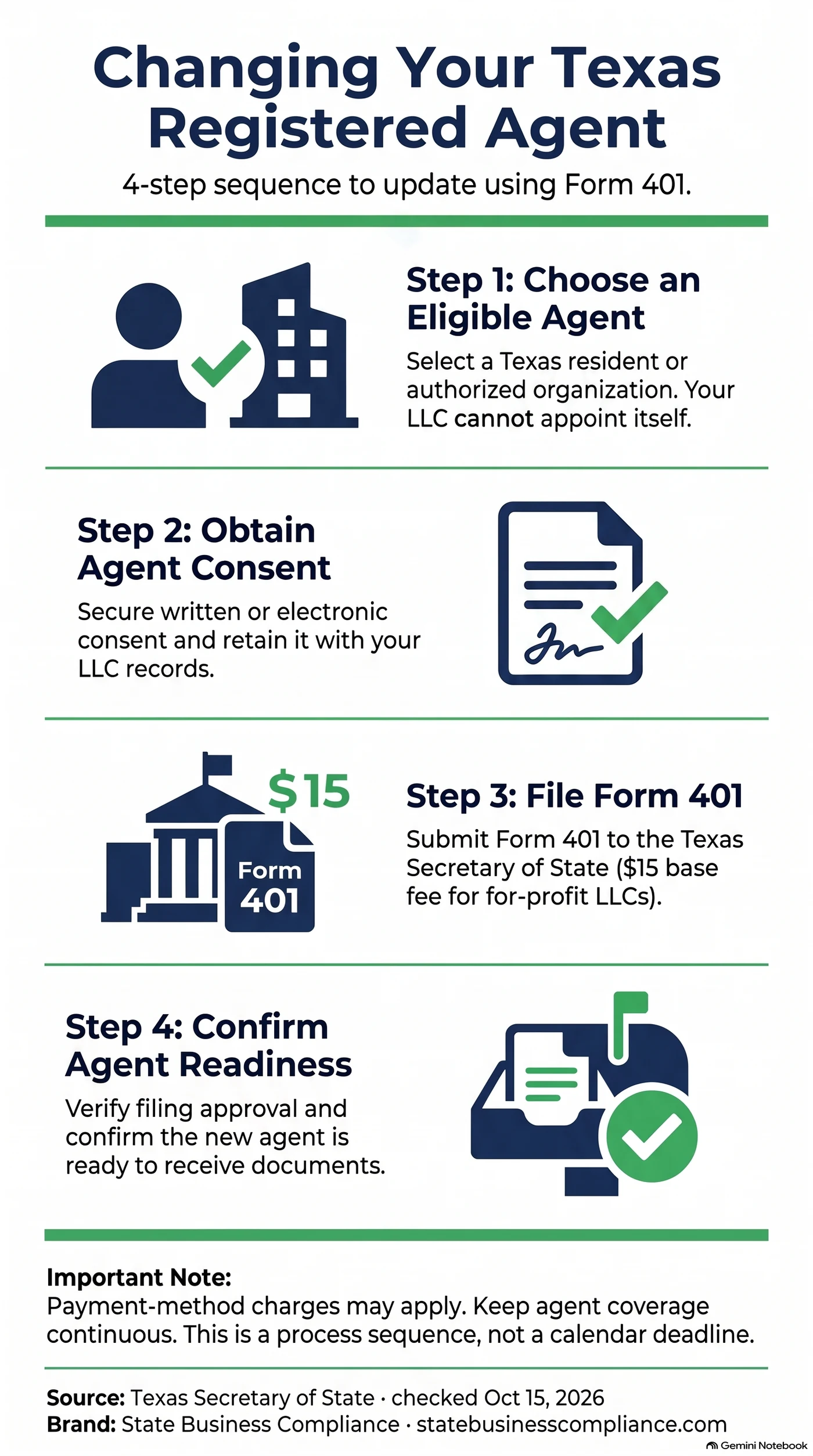 Open full-size Texas agent-change steps
Tip: You can update your registered agent info at any time by filing Form 401 ($15). If your circumstances change (moving, changing jobs, traveling more), file the change promptly so you do not miss service of process or risk involuntary termination.
Want the broader picture before you decide? Read our deep dive on Texas registered agent requirements, the full cost of a Texas LLC, and Texas LLC late-filing penalties.
Do you actually need to pay for a registered agent?
For a lot of Texas LLC owners, no. If you have a physical Texas street address, you are reliably there during business hours, and you do not mind that address sitting in a public database, serving as your own registered agent is free and completely legal. That is the right answer for most single-owner LLCs, and it is the one we would give a friend.
Paying for a service earns its money in three specific situations: you do not live in Texas, you run the business from home and want your home address off the Secretary of State's searchable record, or you travel enough that a process server could miss you. That last one is the expensive one — a lawsuit you never heard about becomes a default judgment.
If you land in one of those three, there are two partners we can point you to, and which is cheaper depends entirely on how long you keep it. Northwest Registered Agent charges $125/year per state with no per-document charges ($100/year per state at five or more states), and they do not sell customer data — the same price every year. Harbor Compliance is $99 for the first year for new customers and $159/year after that under its standard annual terms. Prepaid multi-year offers can change the total.
Compare total charges over the same number of years, including renewals and optional extras. Harbor Compliance advertises prepaid multi-year offers; check eligibility, the prepaid term and the price after it ends. Prices checked on July 26, 2026 (Northwest Registered Agent) and October 17, 2026 (Harbor Compliance) — confirm current terms before buying.
Disclosure: both links below are paid partner links. If you sign up through either one we earn a commission at no extra cost to you — it does not change the price you pay, and it did not change the advice above. We earn from both, so we have no reason to steer you to one over the other. We told you the free option first because it is usually the better one. Full details on our affiliate disclosure page.
We do not review registered agent providers on this site and we are not saying this is the cheapest one. If being your own agent works for you, do that instead — it costs nothing.
Frequently Asked Questions
Can I use my home address as the registered agent address?
What if I work from home but travel frequently?
Can a non-resident be their own registered agent for a Texas LLC?
Is it worth paying for a professional agent to save privacy?
Can I change from being my own agent to a professional service later?
What happens if a process server comes when I'm not home?
Official Source
For the most up-to-date information, always verify requirements with the official Texas Secretary of State website:
https://www.sos.state.tx.us/corpImportant Disclaimer
This article is for informational purposes only and does not constitute legal advice. LLC requirements, fees, and deadlines change frequently. Always verify current requirements with your state's Secretary of State office before making business decisions.
Related Texas LLC Articles
Texas Registered Agent Requirements 2026
Complete guide to TX registered agent rules and requirements.
Texas LLC Taxes & Fees 2026
All costs of forming and maintaining a TX LLC.
Texas Foreign LLC Registration
Registering an out-of-state LLC in Texas.
Texas LLC Late Filing Penalties
Consequences of missing TX LLC and franchise tax deadlines.
Complete Texas LLC Compliance Guide
View all Texas LLC requirements, fees, and deadlines in one place.
View TX State GuideOr compare Texas to every state on the annual report deadlines hub.